

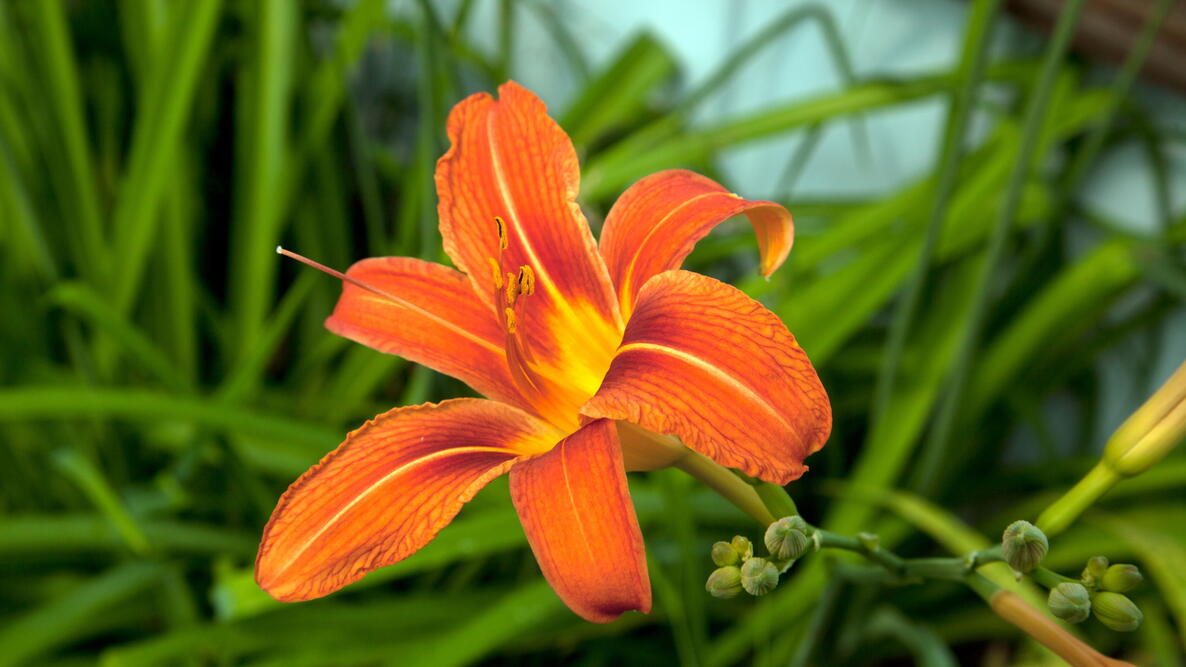
Many gardens become predictable not because the plants are poor, but because too many of them repeat the same rounded shape, the same leaf texture and the same flowering rhythm. Beds filled with neat mounds, domed shrubs and standard border perennials can look competent without ever becoming memorable. Spider daylilies offer a practical way to change that. Their long, narrow petals and open form interrupt the usual pattern of discs, bells and dense flower heads. They bring movement, contrast and a more individual line to mixed planting without demanding difficult care.
That is why specialists often use them as visual disruptors. A spider daylily does not merely add another flower colour to a bed. It changes the drawing of the planting. Instead of a border reading as a series of solid blocks, the eye catches narrow petals, unexpected spacing within the bloom and a lighter, more animated silhouette. This makes nearby plants look better too. Rounded hostas appear more deliberate next to them, compact salvias seem sharper, and ordinary green foliage gains structure through contrast.
A professional view from the premier grower of Daylily plants SwallowtailDaylilies is that gardeners should treat spider forms less as novelty flowers and more as design tools. For readers comparing options or looking at spider daylilies plants for sale, the advice is to focus not only on colour but also on petal width, branch spacing, flowering season and how the plant will break up the dominant shapes already present in the border.
This matters in British gardens, where many plots are compact and often rely on familiar combinations. In those conditions, one plant that changes the character of a border is more useful than several that simply add volume. Spider daylilies can do that in cottage gardens, contemporary schemes and informal suburban planting alike. They are hardy, adaptable and much less demanding than their exotic appearance suggests. Used well, they can turn an ordinary border into something with more pace, depth and personality, while still working within a practical, manageable planting plan.
What makes a spider daylily different from an ordinary daylily
The term “spider daylily” is not just a casual description. It refers to a flower form with petals and sepals that are significantly longer than they are wide, creating a stretched, airy appearance. In specialist circles, the ratio matters because it affects the visual character of the flower. Standard daylilies tend to present a broader face to the viewer, often appearing fuller and more solid. Spider forms do the opposite. They read as linear rather than rounded, and that single difference changes how they function in a planting scheme.
This is important because shape is often neglected by non-specialist gardeners. People usually buy by colour first and flower size second. Specialists often start with form. A narrow-petalled daylily can cut through a border dominated by daisies, roses, hydrangeas or herbaceous clumps. It introduces tension and looseness at the same time. The flowers seem lighter, even when the plant itself is substantial, because so much air remains visible through the bloom.
Another defining feature is how spider daylilies carry themselves on the stem. Many have a more open branching habit, which means flowers are spaced in a way that prevents the plant from reading as a tight block. The effect is especially valuable in borders where plantings have become visually heavy by mid-summer. Instead of adding another dense mass, the spider type lifts the composition and gives the eye places to rest.
Their usefulness also lies in timing. Daylilies, including spider forms, often bridge the period after late spring bulbs and early perennials but before late-summer stars such as rudbeckia and asters fully take over. In design terms, that makes them excellent transition plants. They stop the garden from entering a flat middle period.
There is also a practical advantage that deserves attention. Although the blooms may look unusual, the plants are generally robust and forgiving. They cope with ordinary garden conditions, settle well and do not need the level of staking or fuss associated with some dramatic perennials. That combination of strong visual effect and straightforward performance explains why experts return to them repeatedly. They are not simply collector’s items. They are dependable tools for creating contrast where a border has become too safe, too rounded or too repetitive.
How specialists use spider daylilies to break up flat planting schemes
In ordinary planting, repetition can become monotony. This happens when a border is assembled from reliable favourites that all mature to roughly the same height and form. Cushion-shaped geraniums, rounded roses, compact hebes, domed alliums, mounded grasses and broad-leaved foliage plants may all be excellent individually, yet together they can produce a border with little tension. Specialists use spider daylilies to interrupt that pattern.
One method is to place them where the eye naturally slows down, such as the middle third of a border. In that position, they can bridge lower edging plants and taller background structure. Their flowers hover rather than sit in a solid band, which helps prevent the middle layer from becoming a visual dead zone. In a mixed border, this is often where planting fails. The front is tidy, the back is tall, and the centre becomes a blur. Spider daylilies make the centre legible again.
Another technique is to use them beside strongly rounded plants. The contrast is clearer when the neighbouring forms are simple. A spider daylily beside hostas, clipped box, nepeta or peonies looks intentional because the long petals oppose the nearby mass. The same plant may lose some of its effect if surrounded only by other narrow or wispy forms. Specialists think in pairings, not isolated specimens.
Colour choice supports this structural role. Clear yellows and oranges can create energy, but softer creams, dusky pinks, wine shades and bicolours often work better when the goal is to break up ordinary planting without making the border look chaotic. The unusual shape already does much of the work. There is no need for every variety to shout. A restrained spider form can be more useful than the most dramatic cultivar if it helps the scheme hold together.
Experts also pay attention to rhythm. One spider daylily can act as a punctuation mark, but several spaced through a border can create a repeated visual signal that leads the eye along the planting. This is especially effective in long suburban beds or ornamental strips by patios and drives. The trick is not to overuse them. Too many and the border begins to feel mannered. The specialist approach is measured: enough to disrupt sameness, not so many that the entire scheme becomes dependent on one trick.
Choosing varieties for British gardens and realistic growing conditions
British gardeners often need plants that perform through mixed weather, variable soils and modest space. Spider daylilies can meet those demands, but selection matters. Specialists do not choose varieties purely from catalogue photographs. They consider height, scape strength, flowering period, bud count and whether the flower reads clearly in typical light conditions. A variety that looks spectacular in bright sun may appear duller in a north-facing or cloudier setting, while one with fine contrast markings may be lost from a distance.
Height is a practical starting point. Taller spider daylilies can be highly effective at threading through shrubs or sitting behind lower herbaceous plants, but they need enough presence around them to avoid looking stranded. Medium-height varieties are often the safest choice for ordinary home borders because they integrate more easily. They still provide the distinctive spider form without demanding a complete redesign of the bed.
Soil tolerance is one of their strengths. Most daylilies prefer decent drainage and reasonable fertility, but they are not precious. In many British gardens, that makes them more adaptable than some fashionable perennials that demand sharply drained soils or dry summer conditions. Established clumps usually manage ordinary weather fluctuations well, though they benefit from watering during prolonged dry spells in their first year and at flowering time if conditions are particularly hot.
Flowering sequence is another factor specialists watch carefully. Rather than selecting several varieties that peak at once, they often combine early, mid and later season forms. This extends the period during which the border retains that broken, animated look that spider daylilies provide. It is a useful strategy for gardens that need sustained summer interest rather than one impressive fortnight followed by a visual slump.
Foliage deserves more attention too. Because the leaves form a strappy mound before and after flowering, the plant needs suitable companions. It works well with broader leaves, upright grasses, airy umbellifers and compact shrubs. It is less successful when wedged into already crowded plantings where the foliage cannot read cleanly from spring onwards.
When gardeners search for unusual stock, including spider daylilies plants for sale, the sensible approach is to think first about where the plant will sit and what shape problem it needs to solve. Buying for design function leads to better results than buying simply because a bloom looks exotic in isolation.
Planting combinations that make spider daylilies more effective
A spider daylily is most useful when it is not left to perform alone. Specialists combine it with plants that either emphasise its unusual shape or provide a stable backdrop that prevents the border from looking scattered. The aim is not to create a themed collection but to build a planting composition in which contrast feels deliberate and balanced.
One strong pairing is with broad-leaved plants. Hostas, bergenias and certain heucheras make excellent companions because their solid foliage amplifies the narrow, stretched petals of the daylily flowers. The contrast reads instantly even from a distance. In smaller gardens, this is valuable because a planting effect needs to be clear without requiring long views. Large leaves and spider blooms create that clarity quickly.
Another useful combination is with rounded or cushion-forming perennials. Hardy geraniums, nepeta, alchemilla and low salvias provide a soft mass against which the flowers can hover. This helps the daylilies appear integrated rather than stiff. The surrounding plants also hide the base of the daylily foliage if it becomes untidy later in the season, which is a practical consideration in mixed borders.
Grasses can work well too, though with some caution. Fine-textured grasses may echo the narrowness of spider daylily petals, which can be elegant if the rest of the border includes stronger shapes. If everything is thin and moving, however, the effect can become vague. Specialists often use one upright or architectural grass rather than a whole drift of airy types, so the daylilies still have distinct company.
Shrubs are particularly useful in modern ornamental planting where a border needs backbone. Spider daylilies placed near clipped evergreens or neat deciduous shrubs acquire definition through contrast. The controlled structure of the shrub makes the flowers seem freer, while the daylily softens the rigidity of the shrub line. This exchange is one reason the plant works in both traditional and contemporary gardens.
Colour restraint usually improves these combinations. Mixed planting already contains enough variables in shape, height and leaf form. Where spider daylilies are doing structural work, it often helps to keep neighbouring colours coherent. Repeating greens, purples, creams or warm apricots can make the unusual flower form look intentional rather than accidental. Specialists understand that a border becomes memorable not when every plant competes, but when a few plants alter the rhythm of everything around them.
Care, maintenance and long-term value in the garden
Part of the appeal of spider daylilies is that their exotic look does not translate into difficult maintenance. For ordinary gardeners, this matters as much as design value. A plant that solves a visual problem but creates a practical burden soon becomes a poor bargain. Specialists continue to use spider forms because they are effective without being troublesome.
Planting is straightforward. A sunny position usually gives the best flowering, though light shade can still work, especially in hotter or more exposed sites. Good soil preparation helps them establish, but they are not as demanding as many assume. A moisture-retentive yet reasonably drained soil suits them well. Once planted, they benefit from watering in dry periods during establishment, but mature clumps are generally resilient.
Feeding does not need to be complicated. An annual mulch of compost or well-rotted organic matter often provides enough support in a typical ornamental border. Overfeeding can produce lush foliage at the expense of balanced flowering, so restraint is sensible. Deadheading spent blooms keeps the plant neat, while removing finished scapes after flowering improves appearance and prevents the border from looking stale.
Division becomes useful after several years if flowering declines or the clump outgrows its space. This is less a rescue operation than a routine means of renewal. Dividing established daylilies also allows gardeners to repeat successful plants elsewhere, which can strengthen the rhythm of the garden without extra expense. In that sense, spider daylilies offer long-term value. They are not throwaway perennials that need frequent replacement to maintain interest.
Pest and disease issues are usually manageable in normal garden conditions. The main challenge is often not health but placement. If the plant is stuffed into a crowded border with no thought for its shape, it cannot perform its intended role. The flowers may still appear, but the design benefit is lost. That is why specialists think carefully about spacing, neighbours and sightlines from the start.
A well-chosen spider daylily can keep earning its place for years. It brings a distinct form to the border, fills an awkward seasonal gap and asks for sensible rather than intensive care. For gardeners tired of ordinary planting that feels worthy but flat, it offers something more useful than novelty. It provides structure through contrast, and that is one of the most dependable ways to make an ornamental garden look sharper, more considered and more alive.
