

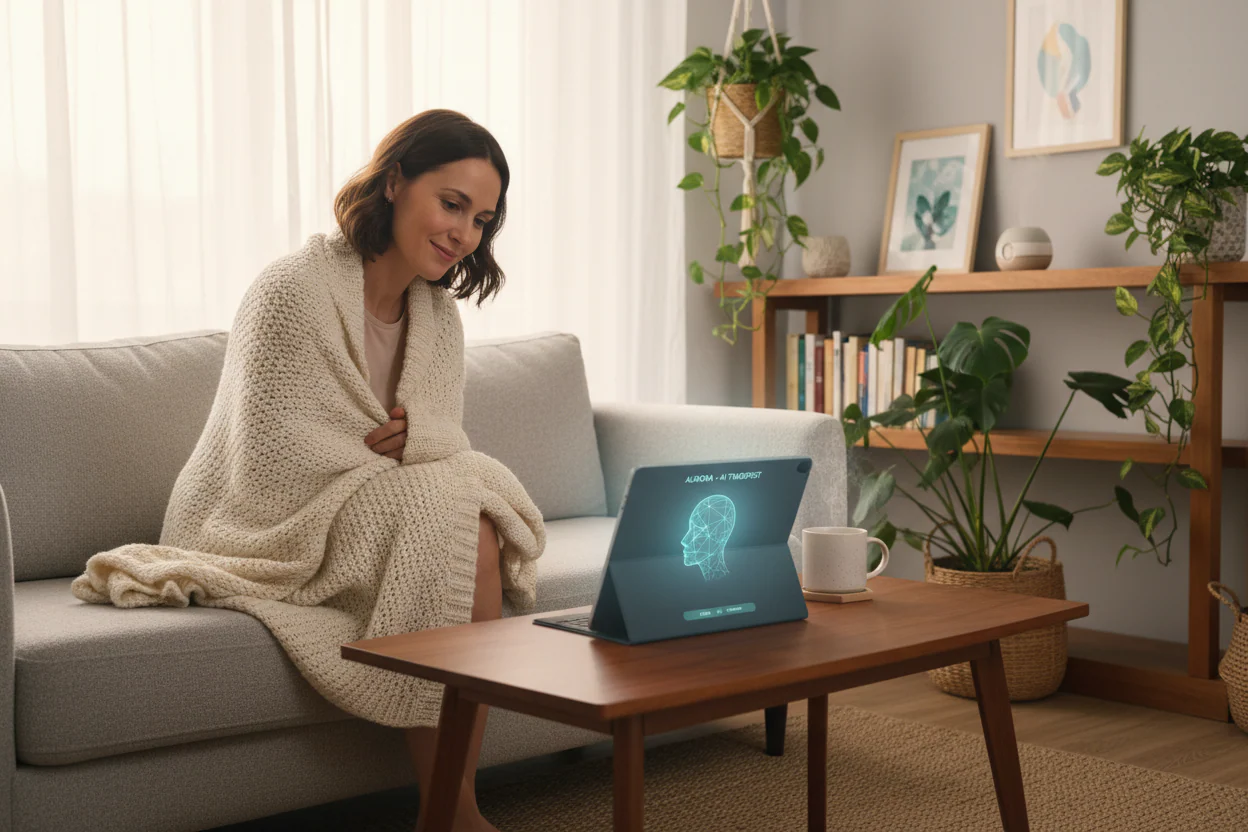
Basic wellness advice can only take you so far. When you hear “Sleep more, stress less, move your body” you know that improving your lifestyle is not that simple, it’s recognizing and dealing with your personal frustrations, difficulties, and circumstances that’s difficult. The good news is, self-care is getting an upgrade and it’s all thanks to AI.
AI journaling platforms as emotional mirrors
The basic concept of journaling is pretty tried-and-true, but there’s an element missing from regular written or app-based methods of tracking your mood and mental state. That’s the principle of “you don’t know what you don’t know.” When we have to tune into and record our feelings consciously, we can only reference what our brains are encoding in the first place. If that’s an overly negative slant on everything, or consistently minimizing our reactions to things, a journal’s also going to reflect that.
AI-powered journaling platforms sidestep that problem by using Natural Language Processing to analyze the emotional tone of your entries over time – spotting patterns in language, recurring anxiety triggers, and mood shifts that you’d likely miss in the moment. Over weeks and months, these platforms build a picture of your inner world that no single journal entry could show. Innermost AI works in this space, using conversational AI to help users track emotional patterns, surface recurring themes, and navigate personal growth in a format that feels like a dialogue rather than a data entry form.
Hyper-personalized recovery protocols
More than 80% of consumers today confirm that personalization is what they seek most in their wellness routines (McKinsey & Company). That makes sense when you take into account how different people’s biologies and stress responses can be – and how similar the guidance they’ve traditionally been given is.
AI wellness engines are altering that by incorporating biometric information from wearables like heart rate variability, sleep data, and resting heart rate patterns, then offering prescriptive suggestions instead of generic ones. So, rather than “attempt to unwind before bed,” the system might notice that your HRV has decreased by 15% that week, and recommend a shorter, low-intensity workout the following day with a specific suggested wind-down routine.
Those suggestions are based on your personal data, not broad averages. That’s the game-changer.
Self-discovery through data synthesis
Figuring out who you are and what makes you tick is a process that used to take years. With a bit of self-awareness and trial and error, you’d gradually start to notice things that drained you, things that lit you up, types of people who tended to put you in a bad mood, and so on. Over the course of a decade or two, you’d piece together a rough map of yourself.
AI compresses and clarifies that process. It takes a bunch of variables that might not obviously feel related – say, sleep quality, diet, exercise, and mood. It shows you that your mood is distinctly worse after socializing with a certain group of people. Or that mental clarity is your lowest-rated well-being category following most social events. Or that an increase in time spent reading each day seems to closely correlate with an increase in your daily mood. Or that throwing fewer social gatherings than typical in a month tends to make you really lethargic.
It’s worth being clear about what this is and isn’t. AI-driven self-discovery isn’t a replacement for therapy, deep relationships, or the slower work of personal growth. But it gives you better raw material to work with. It narrows the gap between who you think you are and the patterns your behavior actually reveals.
Non-judgmental space for emotional processing
One of the lesser-known advantages of AI companions is that they are always there. It’s the middle of the night, they don’t get bored of a certain theme, and they don’t have a discomfort response when you share something really hard. Many AI mental health chatbots implement a CBT (Cognitive-Behavioral Therapy) structure, with prompts to help users identify thought patterns, challenge distortions, and practice reframing techniques in the time between professional check-ins.
This isn’t a substitute for professional care, but having a judgment-free space to think out loud can help people practise vulnerability and process emotions they might otherwise bottle up. The 24/7 availability also matters: emotional processing rarely happens at a convenient time, and having an immediate outlet can make it easier to address feelings rather than suppress them.
Predictive tools for burnout prevention
Self-care in most cases is a reaction. You’re burned out, so you take a rest day. Your sleep has gotten worse, so you try to fix it. Preventive health AI sees that and wants to drag the timeline back a bit.
By combining digital behaviours like screen time, response delays, and typing patterns with physiological stress data from wearables, tools could detect rising stress loads and flag potential burnout earlier. That means support can come before the crash: a micro-habit suggestion, a prompt to take a break, or a warning that your recovery is declining before you consciously feel the change.
This reframes self-care from a luxury you reach for when exhausted to a proactive system running in the background. The goal is to stay ahead of depletion rather than recover from it.
None of this becomes easy, of course. It’s still all about intention and follow through. But you can see yourself clearer and get served exactly what you need that fits the person you are.
